

One Crash Leaves a Whole Lineup Stranded
A loaded car carrier creates an unusual recovery scene. There is the tractor, the carrier itself, and then every car or truck being transported on its decks. After a rollover or serious collision, those vehicles do not necessarily stay exactly where they were loaded. For I-37 heavy towing, that means crews may be dealing with several separate pieces of equipment before the original tractor-trailer can leave the scene.
The number of vehicles is only part of the issue. Their positions on the carrier can matter just as much.
Upper Deck, Lower Deck, Different Problems
Car carriers use their available space carefully. Vehicles may sit above the tractor, on sloped sections of deck, and close together along multiple levels.
That arrangement works for transportation, but a wreck can change the geometry of the entire load. A transported vehicle on the lower deck may remain accessible while one above it is difficult to reach. A bent section of carrier can trap a car in place. Restraints that normally keep a car secure may be under very different forces after a rollover.
Recovery crews therefore need to look at the carrier as a structure, not simply as a trailer full of cars.
The First Car Off May Not Be the Easiest One to Reach
If the carrier cannot be recovered with its load intact, unloading becomes part of the job. The order matters.
A car positioned conveniently near the rear may appear to be the obvious place to begin. But during car carrier recovery on I-37, another vehicle might need to move first because its weight, position, or relationship to a damaged deck affects the rest of the carrier.
Some vehicles may still roll and steer. Others may have collision damage or be pinned against part of the carrier. A recovery plan has to account for those differences rather than treating every car aboard the same way.
Where Do All the Cars Go?
Getting a vehicle off the carrier does not make it disappear. It needs a suitable place at the scene, followed by transportation to wherever it is going next.
That can create a logistical problem during heavy-duty recovery near I-37, particularly if several vehicles must be unloaded. Crews have to think beyond the tractor-trailer itself:
- Which vehicles need to come off?
- Can each one roll and steer?
- Where can they be staged without interfering with recovery work?
- Did any suffer damage during the wreck?
- How will each vehicle leave the scene?
- Will unloading one vehicle change access to another?
A carrier hauling several vehicles can quickly turn one recovery scene into several transportation jobs.
Every Car Removed Changes the Weight
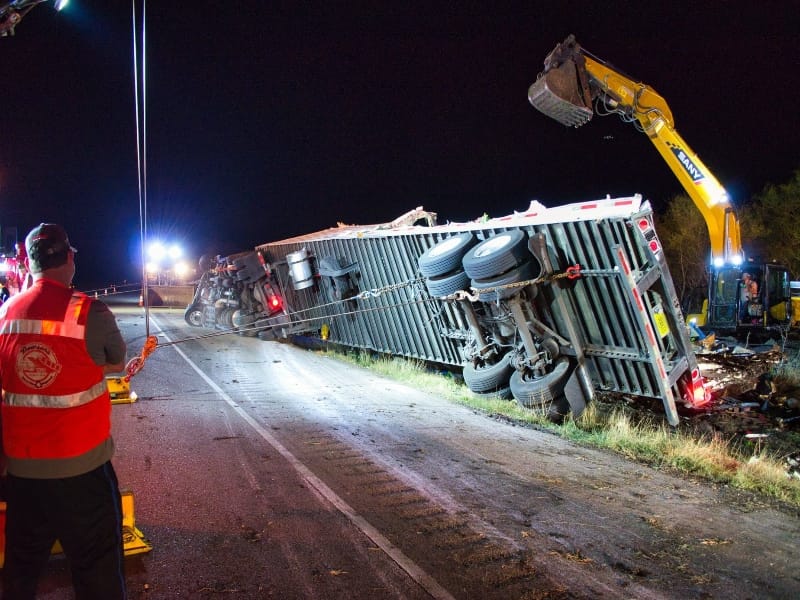
A loaded carrier does not weigh or balance the same after two or three vehicles have been removed. That change can be important when the carrier is lying on its side or sitting at an unusual angle.
During tractor-trailer recovery around I-37, crews have to consider the carrier’s current configuration. Removing a vehicle from an upper deck changes both total weight and where some of that weight is concentrated.
This is one reason unloading and recovery cannot always be treated as separate tasks. Each step can affect the next one.
What If the Cars Stay Aboard?
Sometimes the question is whether unloading is necessary at all.
If the carrier structure and restraints remain suitable for the planned recovery, keeping vehicles aboard may avoid creating multiple additional moves. If the load has shifted or the carrier is damaged, the situation may point in another direction.
For semi recovery along I-37, that decision depends on what crews actually find at the scene rather than a single rule for every loaded carrier.
Uprighting the Carrier Is Not the Finish Line
Even after the carrier is upright, the tractor-trailer still has to leave. Collision damage may affect its decks, axles, tires, suspension, tractor, or other components.
Meanwhile, any cars removed earlier still need transportation. Heavy truck towing near I-37 can therefore become only one part of clearing the incident. The carrier may require a tow while its cargo leaves separately.
The wreck started with one commercial combination. By the end, several vehicles may need their own way out.
Apollo Towing: The Corpus Christi Experts for I-37 Heavy Towing
Apollo Towing serves Corpus Christi and the Coastal Bend, including heavy-duty calls where the cargo itself can shape the recovery. A loaded car carrier is a good example because recovering the tractor-trailer means accounting for every vehicle riding on it.
With heavy towing on I-37, crews may need to manage unloading, staging, changing weight distribution, carrier damage, and separate vehicle transportation as the recovery progresses. For I-37 heavy towing, what begins as one tractor-trailer wreck can become a coordinated effort to move an entire load of vehicles from the scene.
FAQs
Why is recovering a loaded car carrier complicated?
The transported cars are positioned at different heights and angles on an exposed structure. A crash can affect each vehicle, its restraints, and the carrier decks differently.
Do all the cars have to come off before the carrier can be recovered?
Not necessarily. Crews evaluate the carrier structure, load position, restraints, and planned recovery before determining whether unloading is needed.
What happens if one of the transported cars will not roll?
A damaged car may require additional recovery or towing rather than being driven from the carrier. Its condition can also affect the order in which the load is removed.
Where are vehicles placed after they are unloaded?
They need a suitable staging area that does not interfere with the larger recovery operation. From there, arrangements can be made for their transportation away from the scene.
Why does the unloading order matter?
Removing one car changes the carrier’s weight and may change access to other vehicles. The sequence can therefore affect later stages of the recovery.
Can the carrier be towed with cars still loaded?
That depends on the condition of the carrier and its load after the accident. Damage to the decks, restraints, running gear, or other components has to be considered before it can be moved.